Firm Leaders Align Strategies and Collaborate on Best Practices
–
November 17, 2026

The NJCPA hosted a Firm Leadership Forum last week at the Park Avenue Club in Florham Park which provided an opportunity for more than 30 senior leaders from midsize and large accounting firms to candidly discuss shared interests, grooming staff for leadership, artificial intelligence (AI) effectiveness and leveraging technology.
Economic Backdrop
Roosevelt D. Bowman, senior vice president and senior investment strategist at Bernstein Private Wealth Management, was on hand to discuss the broad economic picture for businesses in New Jersey and the U.S. “Our view is that the Fed does hike rates 25 basis points in December, probably not 50, even though that’s been talked about. And then they go two more times in 2027,” said Bowman. He expects the economy to remain resilient, despite pressure from what he called “headwinds like the ongoing war in Iran.”
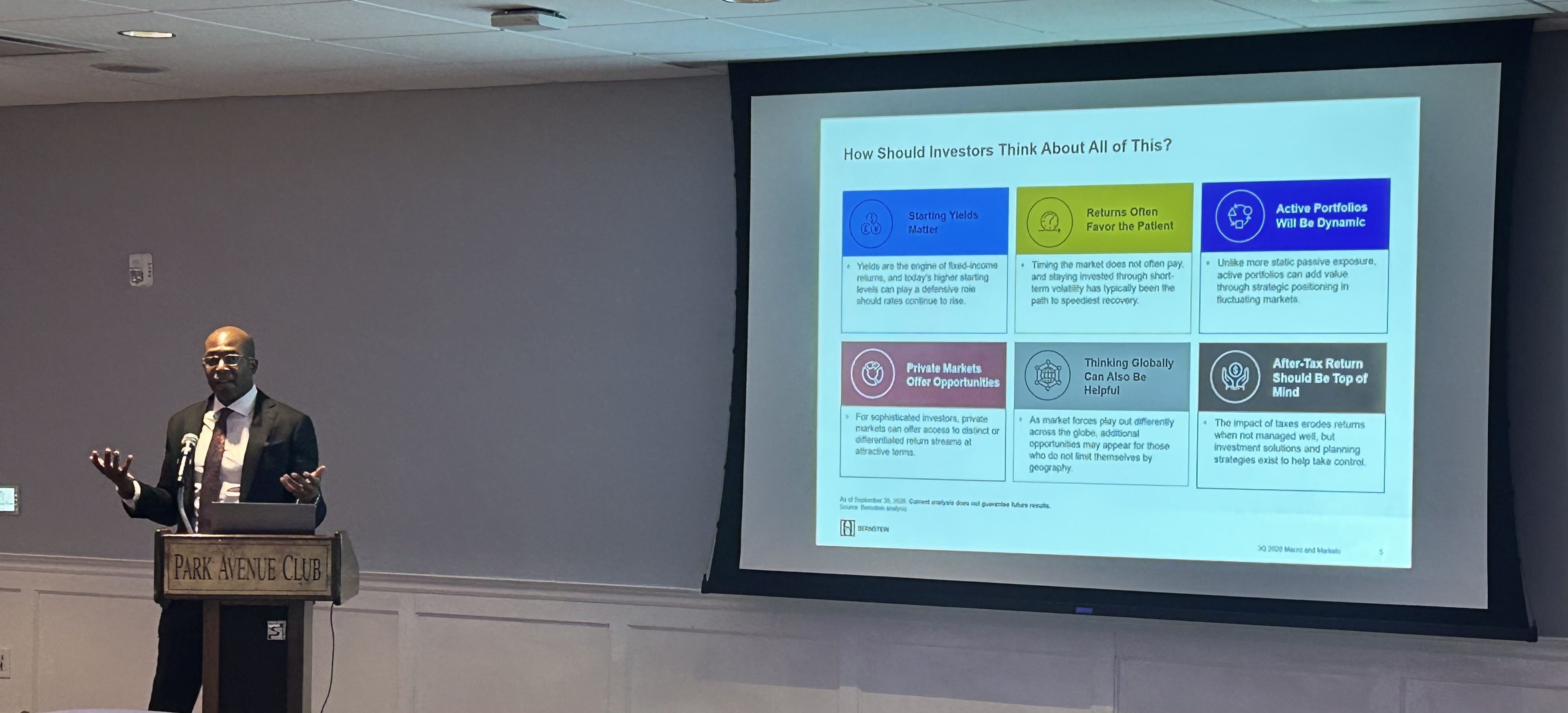 On a broad level, Bowman pointed out that high debt levels are a concern across many developed economies. The U.S., he noted, is among those developed countries that are confronting the issue of “unsustainable debt.” He added that “yields are likely to push higher over the short-term and it will be a while before yields come down. I know that’s important for portfolios, but also for business transactions, mergers and acquisitions.”
State Business Initiatives
In a panel discussion with NJCPA Vice President of Government Relations Jeff Kaszerman, Todd Fisher, senior director of Strategic Initiatives & Economic Opportunity for the State of New Jersey, noted, that Governor Mikie Sherrill’s most recent Executive Order, New Jersey Means Business Economic Development Strategy, which was signed on Nov. 10, represents a “reset with the way the state and the business community interact.”
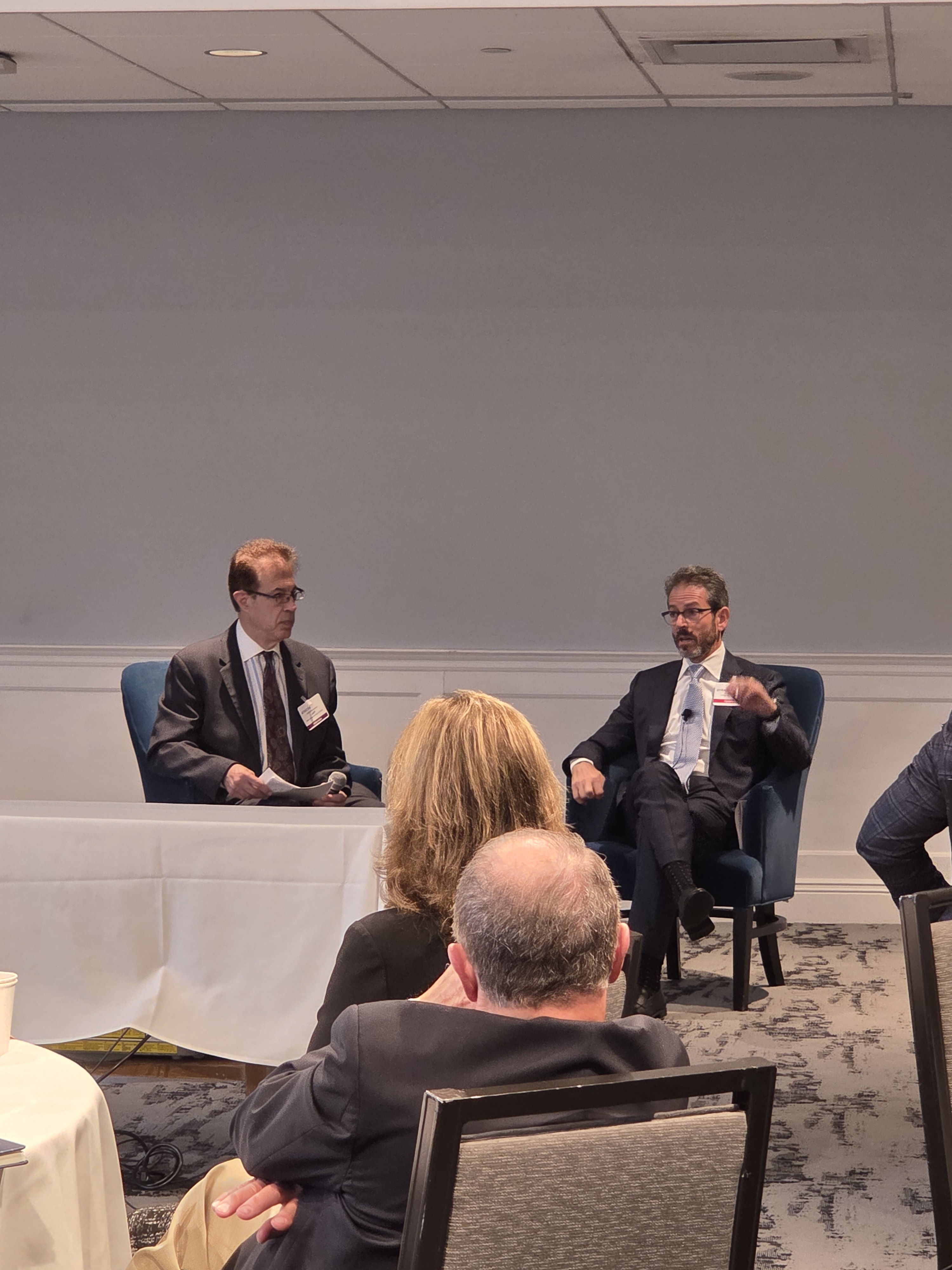 Fisher told attendees that the Executive Order was a result of his team and the rest of the Sherrill Administration performing a listening tour of small to midsize and larger businesses around the state for about nine months. Calling it a roadmap of what they plan to do over the months and years, Fisher said the Order was “to try and influence where New Jersey is from a business-friendliness ability to grow and invest in New Jersey.”
Referring to how the Order organizes the state’s work around four pillars, which include improving the business climate, growing key industries and sectors, increasing research and development and ensuring key constituents can participate in and benefit from economic growth, Fisher said some areas will be scrutinized more than others. “Historically, we haven’t spent enough time, in my opinion, focusing on the core sectors in New Jersey that really are going to be able to drive growth. Some of those are existing sectors, like life sciences and some of them might be newer sectors where we haven’t focused as much time on in the past like defense and aerospace.”
“It really drives me crazy that we are 47th in the country in terms of the research dollars that we attract in New Jersey. When you look at our great research institutions and the infrastructure and assets we have in the state, we should be in the top 10,” he added.
Fisher touted the New Jersey Business Action Center to firm leaders as a good resource for their clients on everything from workforce development to exporting. “It’s a bit of a jewel that most people don’t know about; more people should know about it,” he said.
Hands-On Learning
 Roundtable discussions directed by John Garrett, an award-winning author, comedian, leadership speaker and former CPA, showed attendees that despite various size differences among the firms, there are many universal challenges — as well as opportunities — facing attendees, such as in retirement planning, talent resources, business development and the use of AI.
AI is working well at firms to make tasks more efficient, such as with proposals, emails, tax research and memos, but actual training on the interpretation of what AI is producing is still a work in progress. For some, AI is similar to when computers and Excel came into the field of accounting and professionals had to adjust to using the technology at hand, albeit AI is at even a faster pace.
College curriculums, some attendees said, need to adapt to show students how AI is used in the profession and how to evaluate it. As one attendee noted, “The college curriculum needs to change yesterday,” noting it should pivot away from solely being focused on passing the CPA Exam. Another added that young professionals “need to know how to review a concept and determine what AI spits out is correct.”
As a consequence of AI, billing is also impacted. Several firms now list a technical overhead charge related to AI usage as part of their service fees or have a separate line listing it.
Keeping the Human Side
Over the long term, accounting firms agreed they will also need to keep critical thinking a priority for their staff training. Some firms have a formal coaching/mentorship program already in place as part of their training development.
For Garrett, that sort of training means more emphasis on the “human side” of training. “You can’t not be human and we’re trying so hard to not be human. Everything is about automation, efficiency and productivity and zero emotion,” he added. “Let the tech be the tech. You’re born a critical thinker.”
The profession has also evolved into having not only many “doers,” but also those who are skilled at building client relationships, particularly within client advisory services. Some staff may have a knack for only one part, but others are more willing to be trained to seek out new opportunities.
How a person navigates to the partnership level varies by firm, but also generationally. If some are considered “rainmakers” then their day-to-day tasks may have to be reduced. Challenges exist in getting the right talent in the right positions, attendees said.
The candid breakout sessions registered well with many participants. “Not only did I make connections that are relevant to my firm, but I observed everyone else making connections as well,” admitted Rob Premselaar, CPA, managing partner of Premselaar CPA LLC. “I was sitting at a table of five, with the four others being managing partners of much larger firms, three of which represented firms generating billions in revenue, with national and even global footprints. What struck me was the dialogue had between the five of us (not just the four of them). It was surreal in a sense, and really something special to experience. They were talking shop, swapping experiences and taking notes to bring back to their large firms.”
Chris Lovasz, CPA, managing director at Deloitte and the 2026/27 NJCPA president, reminded attendees that their input was needed during the Forum to understand where the profession is heading and where the NJCPA can make the most difference, such as in supporting firm leadership or advocating for the profession in Trenton. “The NJCPA brings us together, represents our shared interests and helps address challenges that extend far beyond any one firm,” he said.
The event was sponsored by ADP, AllianceBernstein, Citizens and Columbia Bank.